


Double Rub Count: How Durable Should Restaurant Upholstery Be?
10:42 | Mon | 02 November 2026
Double Rub Count: How Durable Should Restaurant Upholstery Be?
Updated November 2026 · By the BESeating team — manufacturing commercial seating since 1993
Quick answer: The double rub count tells you how much abrasion an upholstery fabric survives in a Wyzenbeek test. For restaurant chairs and booths, aim for at least 30,000 double rubs, choose 50,000–100,000 or more for high-traffic seating, and check cleanability, seam strength and colorfastness too, because abrasion alone does not guarantee long life.
When buyers compare upholstery for restaurant chairs and booths, the double rub count is usually the first number on the spec sheet. It is useful, but it is often misunderstood. This guide explains what the number means, how much you really need for each area of a restaurant, and which other ratings matter just as much.

Arizona commercial vinyl range: View Arizona vinyls
Key takeaways
- Double rubs come from the Wyzenbeek test (ASTM D4157); Martindale cycles come from a different test and are not directly interchangeable.
- 30,000 double rubs is the common heavy-duty threshold; busy restaurants often specify 50,000 or more.
- Above roughly 100,000, extra rubs add little real-world benefit; cleanability and seam strength become more important.
- Commercial vinyl usually offers very high abrasion ratings plus easy disinfecting, which suits booths and bar stools.
1) What is a double rub?
A double rub is one forward-and-back pass of an abrasive material across a fabric. In the Wyzenbeek test, a sample is pulled tight and rubbed with cotton duck or wire mesh until it shows noticeable wear, such as broken yarns or a hole. The number of passes it survives is the double rub count. A fabric rated at 50,000 double rubs survived 50,000 back-and-forth passes before visible wear.
The test simulates the friction of people sliding on and off a seat. It is a lab comparison tool, not a promise of a specific number of years, but it is the best quick indicator of how two fabrics will compare in service.
2) How do Wyzenbeek and Martindale tests differ?
| Feature | Wyzenbeek | Martindale |
|---|---|---|
| Unit | Double rubs | Cycles (rubs) |
| Motion | Straight back-and-forth | Figure-eight (Lissajous) pattern |
| Common in | United States | Europe, UK and many global mills |
| Heavy-duty guide | About 30,000 | About 40,000 |
Because the motions and abrasives are different, there is no exact conversion between the two. Treat each rating on its own scale and compare fabrics tested with the same method. Many contract fabrics list both, which makes comparison easier.
3) What double rub count do restaurants need?
The right number depends on how often each seat is used and how guests sit on it. A dining chair in a busy brunch spot sees far more friction than a lounge chair in a quiet hotel corner.
| Area | Suggested minimum (Wyzenbeek) | Notes |
|---|---|---|
| Private dining, low-use lounge | 15,000–30,000 | Decorative fabrics acceptable |
| Standard restaurant dining chairs | 30,000–50,000 | Most common specification |
| Booths and banquettes | 50,000–100,000 | Guests slide sideways along the seat |
| Bar stools and counter seats | 50,000–100,000+ | Frequent on-and-off movement |
| Fast casual, cafeterias | 100,000+ or commercial vinyl | Constant turnover and cleaning |
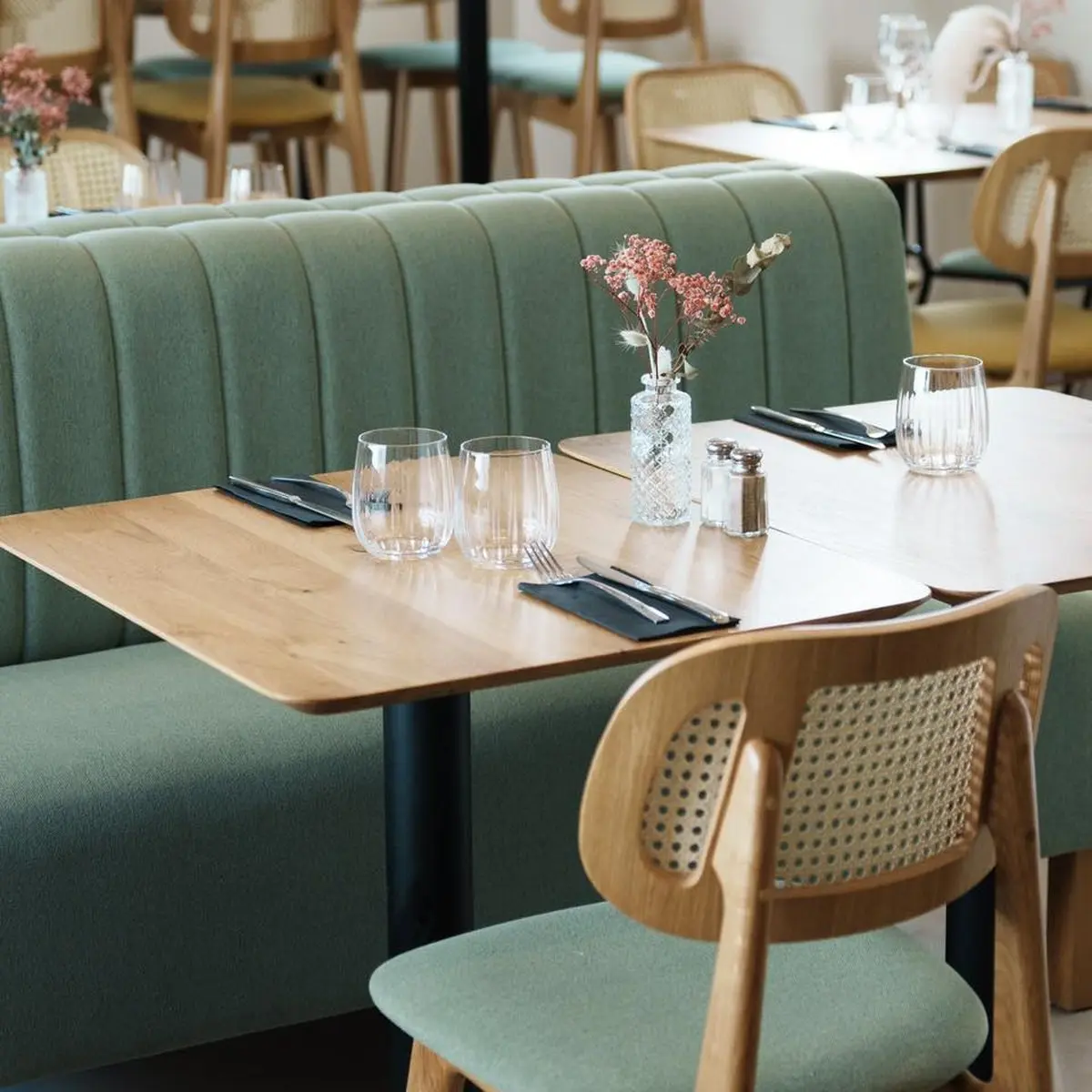
Booth seats deserve special attention. Guests slide along the full length of a booth bench, which concentrates wear at the entry ends. See our restaurant booths collection for booth styles that can be upholstered in high-durability vinyl or fabric.

Double restaurant booth with wood box base: View the double restaurant booth
4) Is a higher double rub count always better?
Not necessarily. Once a fabric passes roughly 100,000 double rubs, the extra durability rarely changes real-world results, because chairs are usually reupholstered for other reasons first: stains, fading, style updates or seam failure. Some very high ratings, such as 300,000 or more, are achieved by stopping the test only when the fabric breaks, while others are stopped at a set point. That makes extremely high numbers hard to compare.
Watch for
- Fabrics with very high rub counts but poor stain resistance.
- Loosely woven fabrics that pass abrasion tests but snag on belt buckles and rivets.
- Spec sheets that list a rub count without saying which test was used.
5) Which other upholstery ratings matter?
Abrasion is only one of several ratings that predict how upholstery performs in a restaurant. Ask for these as well:
- Seam slippage: how well yarns hold at stitched seams under stress; weak seams open up long before the fabric wears through.
- Pilling: whether small balls of fiber form on the surface; rated on a 1–5 scale, with higher being better.
- Colorfastness to light: important for window seats and sunny rooms.
- Crocking: whether color rubs off onto clothing, especially with dark fabrics.
- Flammability: many US jurisdictions and hospitality brands reference California Technical Bulletin 117-2013 for upholstered seating; check your local requirements.
- Cleaning code: W, S, W/S or X tells staff which cleaners are safe.
6) How does commercial vinyl compare with fabric?
Commercial vinyls are typically rated well above 100,000 double rubs and can be wiped with approved disinfectants, which is why they dominate booths, bar stools and fast-casual seating. Fabrics offer more texture, warmth and breathability, and modern performance fabrics have closed much of the cleaning gap.
| Factor | Commercial vinyl | Contract fabric |
|---|---|---|
| Typical abrasion | Very high | Wide range; check each fabric |
| Cleaning | Wipe and disinfect | Blot, spot clean, extract |
| Comfort | Smooth, cooler in AC rooms | Breathable, warmer feel |
| Look | Leather-like or textured | Woven, velvet, boucle and more |
| Best for | Booths, bar stools, high turnover | Dining chairs, lounges, upscale rooms |
Explore our full range of upholstery colors and fabrics to compare both options side by side.

Wood restaurant chair with upholstered seat: View the Bernie PS restaurant chair
7) Does chair design affect upholstery wear?
Yes. Two chairs with the same fabric can wear very differently. Sharp front seat edges, tight corners and exposed welts take the most friction. Rounded front edges, wood frames that protect the upholstered edges, and seats with a slightly waterfall front reduce stress on the fabric. Firm, high-resilience foam also helps, because soft foam lets the fabric stretch and crease with every guest.
- Partially upholstered chairs, with a padded seat on a wood frame, keep the most vulnerable edges in wood.
- Removable seat pads make reupholstery quick and affordable.
- Contrast piping on fully upholstered chairs protects edges and can be replaced.
8) How do you read an upholstery spec sheet?
A useful spec sheet lists the fiber content, weight, abrasion result with the test method, pilling grade, seam slippage, colorfastness, flammability references and cleaning code. If a supplier only shows a color photo and a rub count, ask for the full data before ordering. For multi-location projects, also confirm the fabric is a running line, so you can reorder the same color later.
9) How do you test upholstery durability yourself?
Lab numbers are helpful, but a hands-on test is worth doing. Order swatches and rub them hard with a dry denim scrap to see how quickly the surface changes. Wipe them with your actual cleaning products and check for color loss. Stretch the swatch around a corner and see whether it puckers. Through our restaurant furniture samples program, you can order fabric and vinyl swatches, or a full sample chair, before placing a larger order.

Solid wood chair with upholstered seat and back: View the Sara restaurant chair
10) When should restaurant upholstery be replaced?
Replace or reupholster when you see worn-through spots, split seams, permanent stains or foam that no longer springs back. Catching wear early on a removable seat is much cheaper than replacing an entire chair. Our guide on when to replace restaurant chairs covers the signs in detail, and our article on restaurant upholstery colors helps you choose shades that hide wear between refreshes.
11) How does BESeating approach upholstery?
We offer a wide range of commercial vinyls and fabrics for chairs, bar stools and booths, and we can match upholstery across a full dining room or a multi-location rollout. Every chair, booth and bar stool goes through our quality testing process, and most restaurant chairs arrive fully assembled, so they are ready for service as soon as they are unpacked.
Final recommendation
Use the double rub count as a starting filter, not the final answer. Choose at least 30,000 double rubs for dining chairs and 50,000–100,000 or more for booths, bar stools and fast-turnover seating. Then compare seam strength, pilling, colorfastness and cleaning code, and pick a chair design that protects the fabric's edges. Commercial vinyl is the safest choice for the busiest seats; performance fabric adds warmth where guests linger.
Next step: compare our commercial vinyls and fabrics, order swatches through our samples program, or contact BESeating for help specifying upholstery for your project.
FAQ: Double rub count
What is a good double rub count for restaurant chairs?
For most restaurant dining chairs, 30,000 to 50,000 double rubs on the Wyzenbeek test is a good target. For booths, bar stools and fast-casual seating, choose 50,000 to 100,000 or more, or use commercial vinyl. Always check that the rating names the test method so you can compare fabrics fairly.
Is 100,000 double rubs worth paying for?
For very busy seating, yes, but the benefit above 100,000 is small. At that level, upholstery is usually replaced because of stains, fading, seam wear or a style update rather than abrasion. Spend extra budget on stain resistance, a good cleaning code and strong seams instead of chasing ever higher rub counts.
How do I convert Martindale to double rubs?
There is no reliable conversion because the two tests use different motions and abrasives. As a rough guide, contract textile guidelines treat about 30,000 Wyzenbeek double rubs and about 40,000 Martindale cycles as heavy-duty thresholds. Compare fabrics that were tested with the same method whenever possible.
Does vinyl have a double rub rating?
Yes. Commercial vinyls are also tested for abrasion, and many are rated well above 100,000 double rubs. Vinyl also wipes clean with approved disinfectants, which makes it popular for booths, bar stools and family restaurants. Check the vinyl's cleaning guidance, because harsh solvents can dry out the surface over time.
Does a high double rub count mean the fabric is stain resistant?
No. The double rub count only measures abrasion resistance. Stain resistance depends on the fiber, weave and any protective finish. A fabric can survive 100,000 double rubs and still absorb red wine. Look for the cleaning code, stain-resistant treatments and test swatches with your own cleaning products before ordering.



Be Seating 2010 - 2026 All rights reserved ©
Request a quote
CloseName
Phone
Company name
Industry type
Country
Notes
Please enter the result below
I agree with....
Wrong verification code.
All fields are mandatory
Thank you for your message! We will come back to you shortly.